Are
Marcus Eoin and
Michael Sandison
really Dan and
Sam Houser?
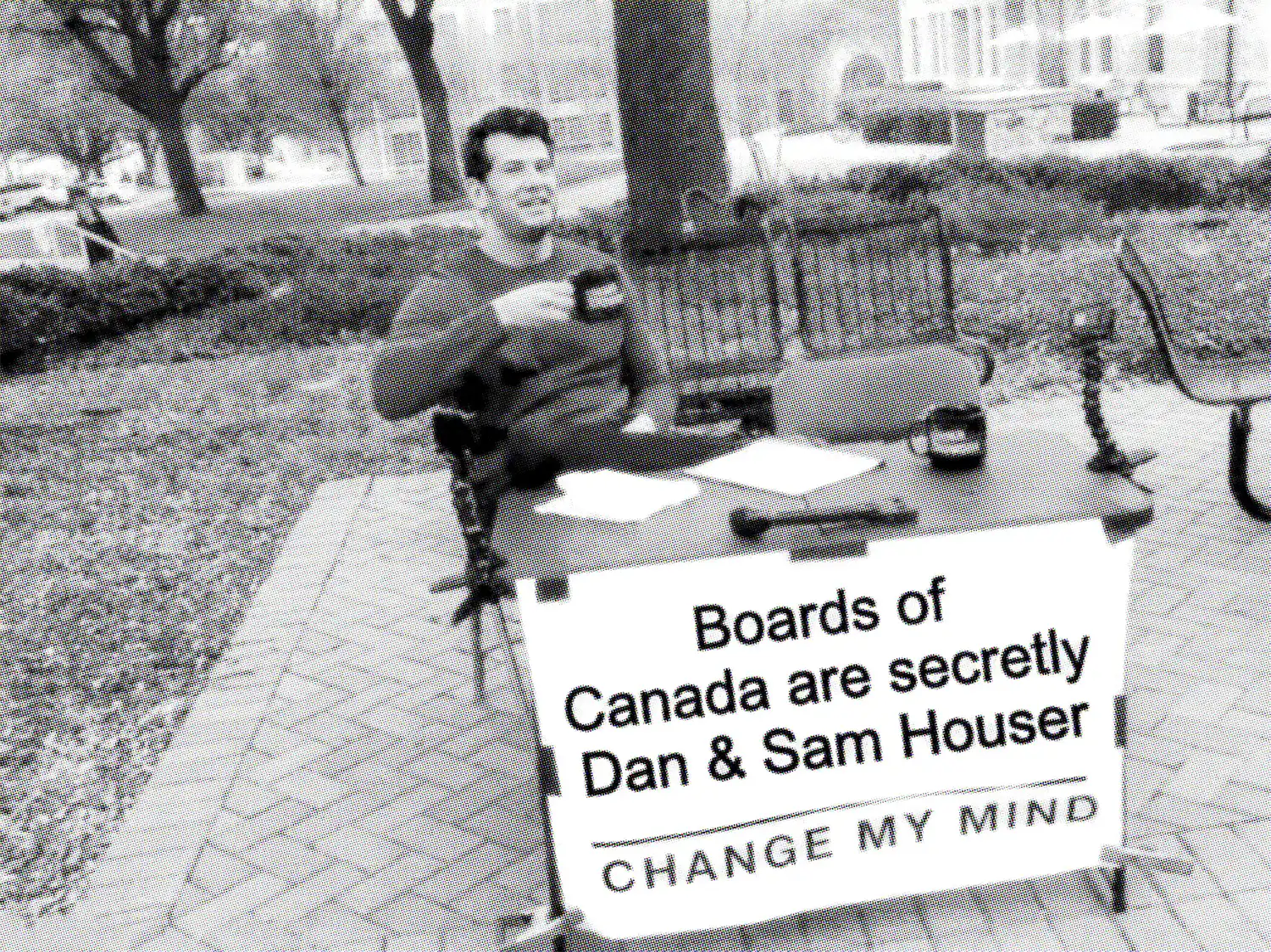
The Brothers
The GTA brothers
 Dan and Sam Houser are brothers who co-founded Rockstar Games together in 1998. Rockstar North, the studio behind Grand Theft Auto, is based in Edinburgh, Scotland. Both brothers are notoriously press-shy, are rarely seen together in public, and let years pass between major releases with little advance announcement.
The BOC brothers
 Michael Sandison and Marcus Eoin are brothers who make music together as Boards of Canada, working out of a studio in the Pentland Hills near Edinburgh, Scotland. Both brothers are notoriously press-shy, are rarely seen together in public, and let years pass between albums with little advance announcement.
Releases
| Year | Grand Theft Auto | Boards of Canada |
|---|---|---|
| 1997-98 |
Grand Theft AutoThe original game, released for MS-DOS and PlayStation. Top-down arcade crime spree across three fictional US-inspired cities, played for chaos and score rather than story. Nostalgic level design referencing US cityscapes, described as a little plain and shoddy, but full of character and style. |
Music Has the Right to ChildrenDebut studio album, released on Warp Records. Featuring vintage synthesisers, degraded analogue production, found sounds and samples, and hip-hop-inspired rhythms. Nostalgic tone referencing US hippy culture, described as crudely made, but also devilishly subtle, intricate and emotionally mature. |
What does this tell us?Both debuts were reviewed as rough around the edges, clearly done on a shoestring, yet somehow the one thing nobody could stop returning to. Nostalgia for an imagined US culture from artists looking at the US outside. |
||
| 1999 |
Grand Theft Auto 2 / LondonGTA2 released alongside the London 1969 mission pack for the original game. GTA2 satirises a near-future city carved up by rival gangs and corporations; London 1969 sends the same arcade chaos up through Swinging Sixties counterculture and Cold War spy plotting. |
Peel SessionAn EP featuring the tracks played on their 1998 Peel Session broadcast on BBC Radio 1. A rawer, more clattering document, valued by critics chiefly as an artefact of a British broadcasting institution rather than a proper release. |
What does this tell us?Neither release this year counts as a proper entry: one is a radio session recorded for the BBC, the other a spoof mission pack bolted onto an old game. Both spend their runtime raiding Britain's own broadcasting and counterculture history. Minor work, low stakes. |
||
| 2000-01 |
Grand Theft Auto IIIFirst entry in the series rendered in 3D. The series begins to focus more on narrative, a silent protagonist's revenge story after being double-crossed by his girlfriend, framing Liberty City's underworld as a betrayal narrative rather than a playground. |
In a Beautiful Place Out in the CountryEP, released on Warp Records. The moment the warmth curdles into paranoia. Narratives emerge via hidden backmasked reference to the Waco siege as "Kid for Today" pulls the record's pastoral title into darker territory. |
What does this tell us?Both of these are a huge leap forward from what came before in terms of craft, quality and ambition. Grand Theft Auto III tells its story through a protagonist who never once speaks. In a Beautiful Place Out in the Country hides its real message behind speech played backwards. Both works bury their narrative behind the sheer immersive impact and trust the audience will go looking. |
||
| 2002 |
Grand Theft Auto: Vice CitySecond 3D-era entry, set in a fictionalised 1980s Miami. One of the highest-selling PS2 games, it doubles down on narrative and mood telling a rags-to-riches ascent through the cocaine trade, staged as an affectionate homage to Scarface and Miami Vice-era excess. |
GeogaddiSecond studio album, released on Warp Records. One of the most universally acclaimed electronic records, the duo's lean in to narrative elements, making a darker more paranoid record. Cult and Waco imagery, deliberate numerology (a 66:06 runtime), and backmasked speech beneath a hypnotic, narcotic pulse. |
What does this tell us?Both releases are commercial and critical peak filled with cult references and deliberate numerology. Post-911 perspectives on an unpredictable US. |
||
| 2004-05 |
Grand Theft Auto: San AndreasFourth 3D-era entry, set across three fictionalised California/Nevada cities. Compared to the focused paranoia of the previous release, this project opens up a wider variety of moods and activities, expanding beyond the city in a world described as living, breathing and visually absorbing. |
The Campfire HeadphaseThird studio album, released on Warp Records. After Geogaddi's cold paranoia this project is a lot warmer and more varied, expanding beyond electronics in its use of acoustic instruments and more open-ended narrative. |
What does this tell us?San Andreas opens into a wider, looser, more physical world than anything before it. The Campfire Headphase opens into a warmer, more organic record than anything Boards of Canada had made up to that point. Both releases document a world relaxing into new certainties and warmth after the fear that came before. |
||
| 2008-09 |
Grand Theft Auto IVFirst entry on the PS3/Xbox 360 generation, returning to GTA III's Liberty City. An immigrant's disillusionment with the American Dream, playing war-veteran trauma and post-9/11 paranoia against a darkly satirical consumer culture. |
Warp20Numerous unreleased tracks, reissues and remixes released through Warp's 20th anniversary celebrations. The group start mining older material for the first time, repackaging it for the demands of their label. |
What does this tell us?GTA IV goes back to Liberty City. Warp20 goes back into the archive. These are both releases that mine the audiences nostalgia of their respective back catalogues, rather than the aesthetic nostalgia usually embedded in the work. Possibly figuring out the changing consumer and distribution networks of the technology by which their work is distributed. |
||
| 2013 |
Grand Theft Auto VReturns to the city of Los Santos. But this version of the city has a stronger narrative focus on Southern Californian celebrity culture, financial-crisis-era greed and reality-TV excess. |
Tomorrow's HarvestReturns to the electronic sounds of Geogaddi, but with a concertedly Californian sound palette, a more menacing and foreboding tone, and themes of isolation and decay through technology. |
What does this tell us?GTA V went back to Los Santos and Tomorrow's Harvest went back to the sound of Geogaddi, both immersed in the aesthetics of California and the vibe shifts of technological change. |
||
| 2026 |
Grand Theft Auto VIAs yet unreleased, we know it is set in and around a contemporary Vice City. Trailers and leaks show a increased focus on rural pursuits (such as fishing), and increased focus on chaotic NPCs (reflecting popular perceptions of Florida), which is famously the locus of power in 2020s global politics. Unlike previous games which we developed by both Houser brothers, this game is being created without the involvement of Dan Houser. |
InfernoThe group once again expand into a wider sound palette, but this time use it to explore allusions to biblical themes, spirituality, and the occult, reflecting the deconstruction of modernist progress narratives experienced in the 2020s. Unlike previous released which were credited to both brothers, this is the first Boards of Canada release to have production and writing entirely credited to just Mike Sandison. |
What might this tell us about GTA VI?Both of these have effectively become solo projects in the 13 years since the last release. If we continue to map similarities between the releases, we can assume that GTA VI will be a more tonally varied project than GTA V. It's likely to embrace more unpredictable, chaotic and emotive narrative elements, while also reaching for more ambitious beats of hope and resolution. It's also seems likely it will reject the nostalgia in favor of being totally located in the present. |
||
What do they say?
Rockstar Games claim they are too busy finishing GTA VI to comment. A Warp Records affiliate who wishes to remain anonymous refused to either confirm or deny the links established on this page.
Does it Matter
None of this is intended to detract from either Boards of Canada or Grand Theft Auto's artistic achievements and everyone involved has their right to privacy. We don't know why the Houser brothers would want to hide their musical identity behind pseudonyms, but it's common enough that we don't need to question it.
This is more interesting when we consider the creative drivers that might cause this. Is Boards of Canada a procrastination project for the brothers to distract them from their day job? Or is it a way of managing the stresses of helming a multimillion dollar game franchise? Is it a way of exploring their creative problems from a new angle in order to gain a better perspective? It would explain the long gaps between Boards of Canada's records if the lads were spending that time getting busy with games.

History is the study of how past events link together through time, place, and human actions. It is not just a list of names and dates, but a way to see why things happened and how they shape our world today. What can we learn and how can we expand our understanding of these works now we have these links?